
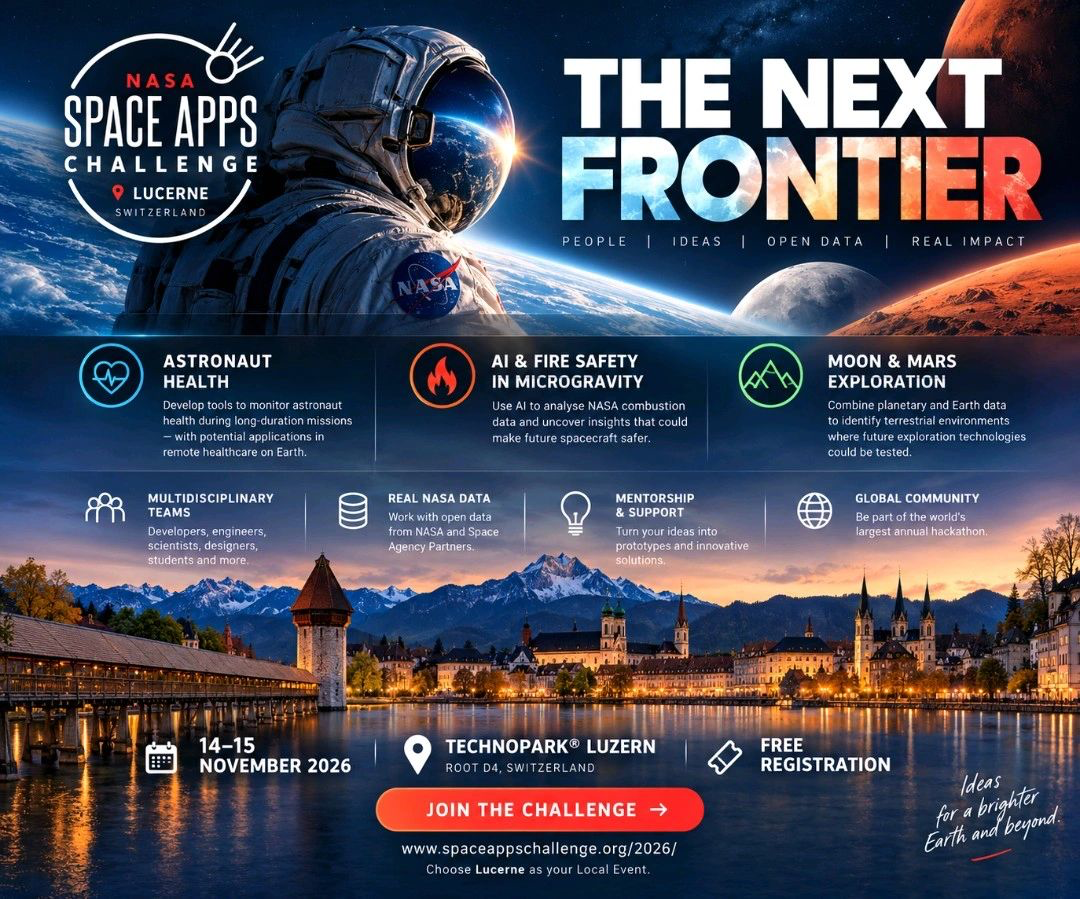
On 14 and 15 November, Technopark Luzern will once again become part of one of the world's largest collaborative innovation events.
For two days, students, engineers, scientists, programmers, designers, entrepreneurs and space enthusiasts will work in multidisciplinary teams, using publicly available NASA data to develop solutions to challenges involving Earth, space and the future of exploration.
The NASA Space Apps Challenge is returning to Lucerne for the second consecutive year.
That continuity matters.
Switzerland is internationally recognised for precision engineering, scientific research, advanced manufacturing and technological innovation. Yet building the next generation of space capabilities requires more than established institutions and specialised companies.
It also requires people who can work across disciplines, interpret complex scientific information and turn ideas into practical solutions.
Events such as NASA Space Apps provide an opportunity to develop precisely those skills.
For the Space Systems Innovation Platform (SSIP), which is supporting the Lucerne edition, the event forms part of a broader commitment to connecting emerging talent with research, engineering and industrial innovation.
The objective extends beyond the competition itself.
It is about strengthening the local community of people capable of contributing to future scientific and technological programmes.
From One Local Event to a Global Community
NASA Space Apps has become an extraordinary example of how open scientific data can mobilise people far beyond traditional research institutions.
The numbers illustrate its scale.
In 2025, the global challenge attracted 114,094 registered participants, with 18,860 teams formed across 551 local events in 167 countries and territories.
Participants worked on problems developed around NASA science and exploration data, producing projects ranging from analytical tools and visualisations to software applications and new approaches to scientific communication.
For most participants, the experience did not involve access to expensive laboratories, specialised hardware or institutional research programmes.
It began with publicly available information, a challenge statement and the ability to collaborate.
This is one of the programme's defining characteristics.
By making scientific datasets accessible, NASA enables a much wider community to examine problems that have traditionally remained within universities, government laboratories and specialist organisations.
A student with an interest in data science can work alongside an experienced engineer.
A designer can help make complex scientific information understandable.
A healthcare researcher can bring a different perspective to a challenge involving human space exploration.
The results may be early-stage prototypes rather than validated technologies, but the collaborative process offers valuable opportunities for learning and experimentation.
In Lucerne, the same principle will guide the 2026 edition.
The Next Frontier: From the Moon to Deep Space
The theme of this year's global challenge is The Next Frontier.
NASA's 2026 programme places particular emphasis on three areas: returning humans to the Moon, preparing for exploration deeper into the solar system, and expanding scientific understanding of the universe.
These priorities reflect some of the most demanding technical questions facing modern space exploration.
Supporting a sustained human presence on the lunar surface requires advances in operational planning, communications, resource management, environmental monitoring and human-system integration.
Preparing for missions to Mars introduces further challenges involving autonomy, spacecraft operations, astronaut health and decision-making at enormous distances from Earth.
Meanwhile, the increasing volume of data generated by space observatories and exploration missions is creating new opportunities for artificial intelligence, modelling and scientific visualisation.
The NASA Space Apps Challenge invites participants to investigate problems inspired by these areas through the use of NASA's free and open datasets and data from its international Space Agency Partners.
The 2026 challenge involves data made available through NASA and 17 participating space agencies.
The emphasis is on collaborative problem-solving, not on possessing specialist aerospace credentials.
Participants do not need to be programmers, professional researchers or experienced space engineers.
They need the ability to contribute ideas, learn from others and work towards a shared objective.
That accessibility makes the challenge particularly relevant to the development of future talent.
Why Lucerne Matters
Lucerne's involvement began in 2025, when the city joined the NASA Space Apps Challenge community with a local event at Technopark Luzern.
The inaugural edition took place on 4 and 5 October, bringing together participants and supporting organisations from Switzerland's engineering, academic and technology communities.
Swiss Engineering played the leading organisational role in the 2025 event, with Technopark Luzern as the hosting partner and contributions from a wider network of institutional and industrial supporters.
The return of the challenge in 2026 builds on that local experience.
Technopark Luzern, located in Root D4, provides an environment where technology companies, entrepreneurs, research organisations and experienced industry professionals already interact.
It is also home to SSIP, an independent Swiss non-profit association working to connect industrial capabilities, scientific research and international innovation opportunities.
The relevance of this environment lies in its proximity to real engineering and industrial experience.
Participants are not simply working in isolation.
They have the opportunity to interact with people familiar with the challenges of developing technologies, managing complex projects and translating scientific concepts into practical applications.
The Lucerne organising community has announced plans for mentoring and expert support during the event, with participation from professionals spanning engineering, innovation, programme development and applied technology.
Among those publicly associated with the 2026 local initiative are Dino Causevic, Paloma Rodríguez Arizpe, Alexander Bisogni, Yvonne Bemelmans and Marco Zerauschek.
Their involvement reflects the multidisciplinary character of the event.
For participants, access to different professional perspectives can be as valuable as the competition itself.
A Different Way to Develop Space Talent
The aerospace industry faces a recurring challenge.
Its technologies are becoming increasingly complex, while many of the skills required to develop them are also in demand elsewhere.
Artificial intelligence, cybersecurity, advanced manufacturing, simulation, electronics, software engineering and biological research all have applications far beyond space.
That creates competition for talent, but it also creates opportunities for people from other sectors to enter the space economy.
A software engineer working on industrial automation may have valuable expertise for an autonomous spacecraft system.
A data scientist specialising in environmental analysis may be well positioned to work with Earth observation datasets.
A biomedical researcher could contribute to studies involving human health and life sciences in space.
A product designer may help transform a highly technical scientific tool into something that researchers and decision-makers can actually use.
The NASA Space Apps Challenge creates an environment in which those different perspectives can meet.
Participants are encouraged to form teams, define an approach to a challenge, work through uncertainty and present the results of their collaboration within a limited period.
These are not trivial skills.
They are relevant to the development of technology in practically every advanced industrial sector.
The event's contribution to talent development should not, however, be confused with formal technical qualification.
A prototype produced over a weekend is not automatically ready for operational deployment.
Its value may instead lie in the ideas tested, the skills developed and the relationships established.
For an emerging innovation community, those outcomes can be significant.
The Opportunity Beyond the Hackathon
Lucerne's 2026 edition follows another important local innovation initiative.
Earlier in October, the Swiss Hackathon 2026 brought international multidisciplinary teams to Technopark Luzern to develop concepts across orbital infrastructure, life sciences, artificial intelligence, advanced manufacturing and other deep-tech fields.
NASA Space Apps introduces a different format and an additional international dimension.
The Swiss Hackathon focused on applied challenges and the potential development of industrial opportunities.
NASA Space Apps connects participants to a global programme centred on open scientific data and challenges developed within NASA's exploration and research framework.
The two initiatives are separate events, with different programme structures and objectives.
But they illustrate a shared principle: complex technological problems benefit from collaboration between people with different skills and experiences.
For SSIP, supporting such initiatives is consistent with its wider role in the Swiss innovation ecosystem.
The association works to bring together industry, academia, technology providers and international partners around applied research and development opportunities.
Hackathons can provide an early point of contact for people who may subsequently become researchers, engineers, entrepreneurs or contributors to collaborative programmes.
What happens afterwards depends on the participants and on the opportunities available.
Some may develop their ideas further.
Others may discover new professional interests or build connections that influence their careers.
Not every project will become a product, a startup or a research programme.
Nor should it need to.
Developing technical confidence, collaborative skills and exposure to scientific problems is already a worthwhile outcome.
An Open Invitation to Switzerland's Next Generation of Innovators
Participation in NASA Space Apps Challenge Lucerne 2026 is free.
The event welcomes people of different ages, backgrounds and experience levels, including those without previous involvement in the space industry.
Participants can join or form teams of up to six members, explore the available challenges and develop a project during the two-day event.
The complete challenge statements are scheduled for release on 28 October, with the hackathon taking place on 14 and 15 November.
Projects submitted through the official NASA Space Apps platform may enter the programme's judging process, with qualifying submissions eligible for consideration beyond the local event.
Participants must register through the official NASA Space Apps website and select their local event.
For those who have considered entering the space sector but assumed it was reserved for highly specialised professionals, the format offers a different starting point.
There is room for scientific thinking, programming, engineering, visual communication, storytelling and creative problem-solving.
The essential requirement is a willingness to collaborate.
Two Days in November. A Longer-Term Opportunity for Lucerne.
The second consecutive edition of NASA Space Apps Challenge Lucerne comes at a time when Switzerland's space and deep-tech communities are exploring how to connect established industrial strengths with a new generation of technological opportunities.
The event will not, by itself, resolve the skills challenges facing the space industry.
It will not turn every participant into a space entrepreneur.
And it will not transform every prototype into an industrial programme.
What it can do is create an accessible environment for people to work together on meaningful scientific challenges, encounter new disciplines and develop connections that might otherwise never occur.
For Lucerne, the continuation of NASA Space Apps is an opportunity to strengthen a local innovation community while remaining connected to a much larger international network.
For SSIP, it reinforces the importance of bringing engineering, science, technology and emerging talent into the same environment.
And for those taking part, the opportunity begins with something far simpler than building a spacecraft.
It begins with a problem, an idea and a group of people willing to explore it together.
The next generation of space innovators will not all come from the aerospace industry. Some may discover their place in it over a single weekend in Lucerne.
Event details
NASA Space Apps Challenge Lucerne 2026
14–15 November 2026 · Technopark Luzern, Root D4 · Participation is free
Sources & context
This preview draws on SSIP’s supplied event information and the official NASA Space Apps Challenge platform. Images are promotional material supplied by the local organisers. NASA does not endorse any non-U.S. Government entity; references to NASA describe the global challenge format.
About SSIP
SSIP® is an independent Swiss non-profit association headquartered at Technopark Luzern, connecting industry, research institutions and international partners to structure applied innovation initiatives.
Discuss a technical or industrial challengeWas this article useful?
Your feedback helps us improve SSIP Insights.
Share it with your network.