Lucerne, Switzerland — 16 October 2026
The next meaningful advance in space biotechnology may not come from a new spacecraft. It may begin with a question raised in a regenerative medicine laboratory: can changing the gravitational environment reveal something about cellular behaviour that conventional research has yet to establish?
That question is increasingly relevant to a new collaboration taking shape in Switzerland.
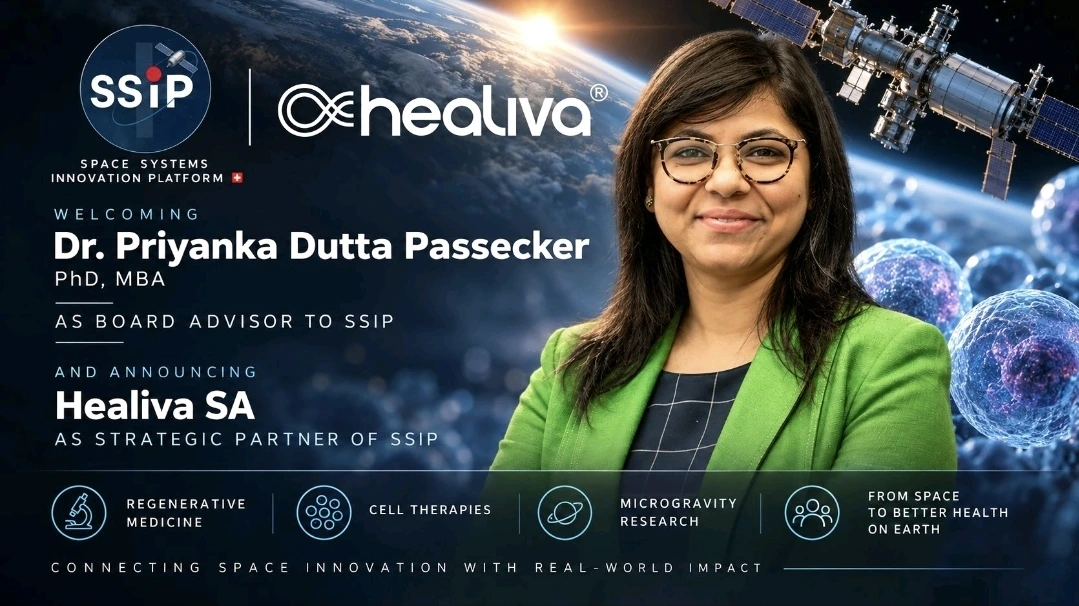
The Space Systems Innovation Platform (SSIP®) has welcomed Dr. Priyanka Dutta Passecker, PhD, MBA, to its Board of Advisors, while strengthening its strategic partnership with Healiva SA, a Swiss biotechnology company focused on regenerative medicine and chronic wound care.
The announcements carry particular significance because the relationship extends beyond institutional alignment. Healiva, SSIP and the Lucerne University of Applied Sciences and Arts, through HSLU/BIOTESC, are already working together on collaborative projects, bringing complementary expertise in cell therapies, space biology and applied research into a shared development environment.
For SSIP, this is an important step in connecting Switzerland's biomedical capabilities with emerging opportunities in microgravity research.
An Advisor Who Understands the Science and the Business
Dr. Priyanka Dutta Passecker brings an unusually relevant combination of biotechnology entrepreneurship, scientific knowledge and commercial leadership.
As co-founder and CEO of Healiva, she has worked at the intersection of regenerative medicine, cell-based therapies and the challenge of translating biomedical innovation into solutions for patients.
Healiva's development portfolio reflects that practical orientation. The company is pursuing approaches to chronic wound care that include cell therapies, enzyme-based technologies and complementary medical devices.
Such work involves far more than demonstrating scientific feasibility. Advanced therapies must also confront questions of manufacturing, quality, reproducibility, regulatory development and accessibility.
These considerations are especially important as the space industry seeks to demonstrate whether microgravity can contribute useful evidence or new capabilities to pharmaceutical and biotechnology research.
Dr. Dutta Passecker's appointment strengthens SSIP's advisory expertise in precisely this area: connecting promising science to the requirements of industrial development and eventual clinical application.
Healiva and SSIP: A Partnership Already in Motion
The strategic relationship between Healiva and SSIP is not being built around an abstract vision of space medicine.
It is being developed through active collaboration.
Together with HSLU/BIOTESC, the organisations are already engaged in joint project work, bringing biotechnology development, academic research and space-enabled experimentation into closer alignment.
The collaboration creates a framework for investigating research questions relevant to regenerative medicine and advanced cell therapies, including where altered gravitational conditions might provide scientifically useful insights.
The objective is not to assume that microgravity will automatically improve biological products. It is to identify specific questions for which the gravitational environment could influence cellular behaviour, physical transport processes or experimental observations in ways worth investigating.
Any such advantage must be demonstrated through appropriately designed studies, terrestrial controls, reproducible measurements and evidence relevant to the intended biomedical application.
That distinction matters.
Microgravity can provide a different experimental environment. Whether that difference translates into useful therapeutic knowledge, improved development processes or industrial value remains dependent on the application and the evidence generated.
For this collaboration, scientific credibility and practical implementation must progress together.
The Role of HSLU/BIOTESC
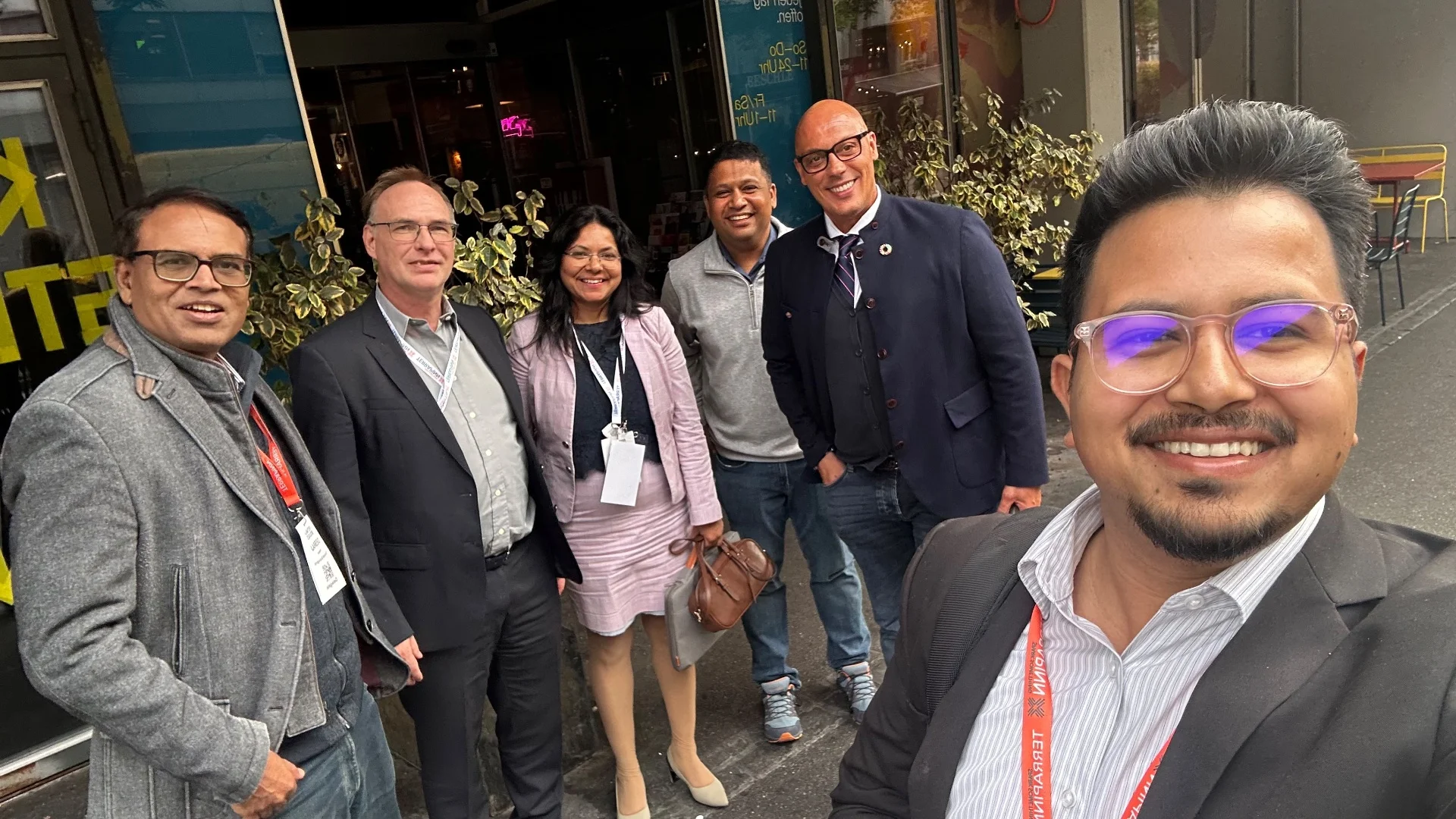
A central element of the collaboration is the involvement of HSLU/BIOTESC, part of the Lucerne University of Applied Sciences and Arts' established space-biology research environment.
BIOTESC brings experience in the scientific and operational requirements of biological research associated with space missions, including work supporting European Space Agency activities.
This provides important complementary expertise alongside Healiva's biotechnology focus and SSIP's role in connecting industrial, scientific and international partners.
The combination brings together three distinct but mutually reinforcing capabilities:
Healiva SA contributes knowledge of regenerative medicine, cell-based product development and the practical requirements of biomedical translation.
HSLU/BIOTESC contributes space-biology expertise, research capabilities and understanding of the experimental challenges associated with altered gravity environments.
SSIP® provides the independent collaboration platform through which expertise, research infrastructure, project development and international opportunities can be brought together.
The value lies not simply in the organisations' individual capabilities, but in their ability to frame credible projects with defined scientific questions and realistic implementation pathways.
Why Regenerative Medicine Matters to the Space Economy
For decades, research in microgravity has generated knowledge about how biological and physical systems respond when gravity-dependent processes are altered.
But producing an interesting experimental result is different from demonstrating value to the pharmaceutical industry.
For regenerative medicine, researchers must understand whether an observed change in cellular behaviour is relevant to a defined therapeutic mechanism, a manufacturing challenge or a development decision.
Questions of experimental controls, biological variability, sample quality, analytical consistency and regulatory relevance cannot be secondary considerations.
They determine whether an observation can progress beyond scientific curiosity.
This is where a collaboration linking a biotechnology developer, an experienced space-biology research organisation and an independent innovation platform becomes strategically relevant.
Rather than beginning with the availability of a spaceflight opportunity, the partners can begin with the biomedical problem, assess the scientific rationale and determine which experimental environment is appropriate.
That may involve terrestrial research, ground-based altered-gravity simulation or, where justified, future access to actual microgravity platforms.
The research pathway must follow the evidence, not the other way around.
From Scientific Opportunity to Practical Execution
The appointment of Dr. Dutta Passecker and the partnership with Healiva also reflect a broader evolution in SSIP's activities.
Based at Technopark Luzern, SSIP operates as an independent Swiss non-profit platform connecting companies, research institutions and international organisations around applied innovation.
In life sciences, that means helping translate emerging research opportunities into structured collaborations that can be assessed, funded and executed.
For biotechnology companies, the challenge is not simply gaining access to space-related infrastructure. It is understanding whether that infrastructure can provide measurable scientific or industrial value.
For research institutions, the challenge is ensuring that experiments address meaningful questions and generate interpretable results.
For the space industry, the challenge is demonstrating that its platforms can become reliable components of biomedical research and development rather than isolated technological demonstrations.
The ongoing work between Healiva, SSIP and HSLU/BIOTESC represents a practical approach to connecting these requirements.
A Collaboration with a Clear Purpose
The long-term significance of this relationship will be determined by the quality of the projects developed, the evidence they generate and the ability of the partners to translate research findings into decisions that matter.
No single experimental platform, partnership announcement or advisory appointment can establish a therapeutic breakthrough.
What these developments can provide is a stronger foundation for asking the right scientific questions and assembling the expertise needed to answer them.
With Dr. Priyanka Dutta Passecker joining its Board of Advisors, Healiva established as a strategic partner, and collaborative project work already underway with HSLU/BIOTESC, SSIP is bringing together three areas that have too often advanced separately: space research, regenerative medicine and industrial biotechnology.
The opportunity is not simply to take biomedical research into space.
It is to determine where space-enabled research can genuinely contribute to better science, more informed development decisions and, ultimately, better healthcare on Earth.
Sources & context
This announcement concerns an advisory appointment to the SSIP Board of Advisors, not the statutory Association Board. HSLU/BIOTESC is an independent part of the Lucerne University of Applied Sciences and Arts; its ESA-related work does not imply ESA endorsement of this collaboration. No project funding, clinical outcome or orbital experiment result is reported here.
About SSIP
SSIP® is an independent Swiss non-profit association headquartered at Technopark Luzern, connecting industry, research institutions and international partners to structure applied innovation initiatives.
Discuss a life-sciences collaborationWas this article useful?
Your feedback helps us improve SSIP Insights.
Share it with your network.