Europe's space industry is entering a period in which the ability to launch a spacecraft is only part of the competitive equation.
Satellites are becoming smaller and more capable. Commercial operators are exploring new services in low Earth orbit. Pharmaceutical companies are investigating research opportunities beyond terrestrial laboratories. Manufacturers are developing components for increasingly demanding environments.
Yet between a promising technology and a system ready for deployment lies a series of challenges that are often underestimated.
Scientific feasibility must become an engineering specification. Components must be designed, integrated and tested. Materials must survive operational environments. Experimental hardware needs to function reliably beyond the laboratory. Industrial suppliers must meet demanding quality and traceability requirements.
None of those steps necessarily belongs to the same organisation.
That is the industrial problem behind an initiative being brought to Space Tech Expo Europe 2026 in Bremen.
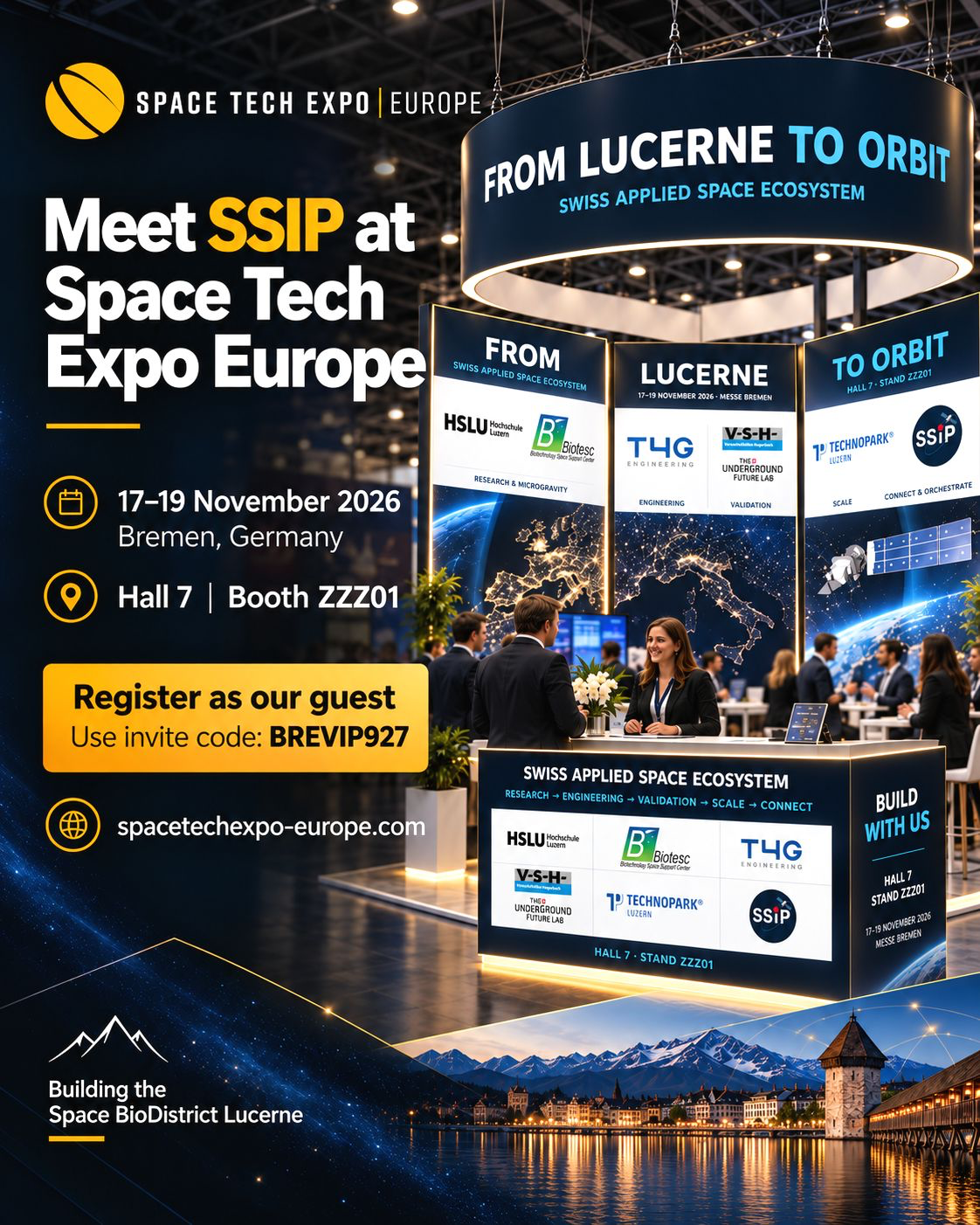
From 17 to 19 November, According to SSIP’s exhibition announcement, Switzerland's Space Systems Innovation Platform (SSIP®) plans to exhibit alongside Lucerne University of Applied Sciences and Arts (HSLU/BIOTESC), T4G Engineering, VSH — The Underground Future Lab and Technopark Luzern.
The five organisations will share a presence in Hall 7, Stand ZZZ01, bringing together capabilities spanning scientific research, specialised engineering, experimental validation, entrepreneurship and international project development.
The proposition is not that any one organisation possesses every capability required for a space mission.
It is that connecting complementary capabilities early could reduce the distance between a promising concept and a technically credible industrial programme.
The Space Economy Is Becoming an Industrial Supply-Chain Challenge
Space Tech Expo Europe has evolved into one of the industry's major business meeting points.
The exhibition brings together suppliers, manufacturers and technology specialists, alongside conferences addressing industrial developments and commercial space applications.
Bremen itself is an established European aerospace centre, home to major companies including Airbus Defence and Space, OHB and ArianeGroup, together with research institutions and specialised suppliers.
The setting matters.
As the commercial space economy expands, competitive advantage increasingly depends on the ability to bring different technologies and industrial capabilities into a reliable supply chain.
A successful space project may involve dozens of specialised suppliers, each responsible for a different technical function.
Some develop mission hardware. Others provide precision components, advanced materials, sensors, electronics, software, testing systems or scientific expertise.
Their contributions must ultimately work together under demanding operational conditions.
For smaller companies and research institutions, entering that environment can be difficult.
A technology may be scientifically promising yet lack the engineering maturity, test evidence, industrial partners or project structure needed to attract a customer.
It is within this gap that the Swiss participants intend to position their collaborative approach.
Five Organisations, Five Complementary Capabilities
The organisations heading to Bremen represent different parts of the journey from research to industrial application.
HSLU/BIOTESC: Translating Science into Executable Experiments
Lucerne University of Applied Sciences and Arts contributes scientific and experimental expertise through its space biology activities and Biotechnology Space Support Center (BIOTESC).
Based in Hergiswil, BIOTESC supports biological experiments conducted aboard the International Space Station under European Space Agency programmes.
Its work involves considerably more than scientific observation.
Experiment preparation, ground testing, operational procedures, biological sample handling and support for astronaut activities all form part of a highly specialised process.
That experience is relevant to an emerging market in which pharmaceutical companies, biotechnology developers and research organisations are considering whether microgravity can help answer questions that are difficult to investigate on Earth.
The scientific requirements are demanding, and access to space alone does not guarantee meaningful results.
T4G Engineering: When Performance Must Survive the Real Environment
T4G Engineering contributes specialised expertise in mechanical, acoustic, vibration, thermal and multiphysics engineering.
For space-related hardware, these disciplines can be decisive.
A component that performs adequately under laboratory conditions may behave differently when exposed to mechanical loads, thermal gradients, vibration or complex integration constraints.
T4G develops tailored engineering solutions, including specialised materials and systems for acoustic and vibration management, supported by modelling, simulation and testing.
Its expertise highlights an important industrial reality: reliable space systems are built through detailed engineering work, not solely through breakthrough concepts.
VSH — The Underground Future Lab: Experimentation Beyond the Conventional Laboratory
The Hagerbach Test Gallery, known as VSH — The Underground Future Lab, brings a different form of infrastructure to the collaboration.
Its extensive underground environment supports research, experimentation, technology demonstration and validation activities under controlled and realistic conditions.
For projects involving infrastructure, robotics, sensing, communications or demanding experimental environments, such facilities may offer opportunities that are difficult to reproduce in conventional laboratories.
The potential relevance to space-related engineering lies in investigating suitable analogue environments, experimental installations and testing approaches.
Specific space testing or qualification activities would still require appropriate technical assessment, facility configuration and agreed verification requirements.
Technopark Luzern: Connecting Technology with Entrepreneurship
Innovation infrastructure extends beyond laboratories and test facilities.
Companies need access to business networks, experienced partners, entrepreneurial support and opportunities to develop their market position.
Technopark Luzern provides an environment in which startups, technology companies, research organisations and established industrial actors can interact.
Its role in the Bremen collaboration introduces an important dimension often overlooked in engineering discussions: even technically promising innovations require an organisational and commercial pathway towards adoption.
SSIP: Coordinating the Connections
SSIP brings these complementary capabilities into an international collaboration framework.
The independent Swiss non-profit association works across research, industry, technological infrastructure and international partnerships.
Its role is to identify relevant capabilities, bring suitable organisations together and support the structuring of projects around defined technical and industrial objectives.
That can include connecting scientific requirements with engineering expertise, identifying potential validation pathways, establishing contact with international technology providers and exploring suitable collaborative development models.
SSIP does not replace the individual organisations' technical responsibilities.
Its function is to help make their capabilities easier to combine.
Why the Model Matters for Microgravity and Orbital Infrastructure
Consider a biotechnology company interested in testing a biological process under microgravity conditions.
The initial scientific question may appear straightforward.
But a meaningful experiment could require expertise in biological sample preparation, specialised hardware, thermal management, fluid handling, data collection, payload integration and post-flight analysis.
Depending on the experiment, it may also require access to a suitable orbital platform and reliable sample return.
No single scientific insight resolves those dependencies.
A comparable situation exists in orbital infrastructure.
A concept for an orbital service, experimental module or spacecraft subsystem may depend on multiple organisations providing design expertise, specialist components, suitable testing and operational integration.
The challenge is therefore not only to identify new technologies.
It is to organise the industrial and scientific capabilities needed to evaluate and implement them.
For Switzerland, this presents an opportunity.
The country has longstanding expertise in precision engineering, life sciences, advanced manufacturing, specialised materials and industrial automation.
Many of these capabilities have potential applications in space-related programmes, even when the companies developing them do not primarily identify themselves as space businesses.
Connecting those capabilities to international project requirements could create additional industrial opportunities.
But that process must be grounded in real customer needs, technical specifications and qualified delivery arrangements.
A network of organisations is useful only when it helps overcome those practical barriers.
From Lucerne to Europe's Space Industry
Bremen will provide a direct opportunity to test this approach against the requirements of the wider European market.
For SSIP and the participating organisations, the intended conversations extend across microgravity life sciences, experimental hardware, advanced manufacturing, materials engineering, testing, orbital infrastructure and international technology collaboration.
The objective is to meet organisations facing identifiable technical or industrial challenges, understand the capabilities they need and explore whether suitable partners can help address them.
Such discussions may lead to feasibility studies, joint development proposals, industrial partnerships or potential consortium projects.
Those outcomes cannot be assumed in advance.
The effectiveness of the approach will depend on the quality of the technical opportunities identified, the commitment of participating organisations and their ability to establish realistic development plans.
But the logic behind the initiative reflects a broader trend.
As space becomes more commercially accessible, the economic opportunity is expanding beyond traditional spacecraft manufacturers.
It increasingly involves the network of specialists capable of designing, validating, manufacturing and supporting complex systems.
For smaller and highly specialised companies, participation in that network may become as important as developing a particular technology.
The Real Measure Will Come After Bremen
Trade exhibitions create visibility.
They offer opportunities to meet customers, discover suppliers and establish international relationships.
But industrial progress is ultimately measured elsewhere: in requirements agreed, technologies validated, projects financed, systems delivered and collaborations sustained.
The five organisations travelling to Bremen are not presenting a single integrated product or claiming that their combined capabilities automatically constitute a complete space programme.
They are presenting complementary expertise and an approach to structuring collaboration around specific technical needs.
That distinction is central to the SSIP model.
It is also relevant to Europe's wider industrial ambitions.
A competitive space economy requires launch capacity, spacecraft manufacturers and mission operators. It also requires dependable specialists, strong research institutions, experimental infrastructure and effective collaboration between organisations.
The companies and institutions capable of connecting those elements may help determine how quickly new technologies move from early promise towards industrial use.
From 17 to 19 November, SSIP, HSLU/BIOTESC, T4G Engineering, VSH — The Underground Future Lab and Technopark Luzern will bring that proposition to the European space industry.
Hall 7, Stand ZZZ01, Messe Bremen.
The exhibition will last three days. The real test will be what those three days make possible afterwards.
Meet the SSIP Ecosystem in Bremen
Space Tech Expo Europe 2026
17–19 November 2026 · Messe Bremen, Germany
Hall 7 · Stand ZZZ01
Participating organisations
- SSIP®
- Lucerne University of Applied Sciences and Arts — HSLU/BIOTESC
- T4G Engineering
- VSH — The Underground Future Lab
- Technopark Luzern
Invitation code: BREVIP927
Register as our guestSources & context
This preview is based on SSIP’s supplied exhibition announcement. Participation, stand location and invitation code are supplied by SSIP. Collaboration opportunities are prospective, not announcements of funded projects, certified facilities or completed commercial agreements.
About SSIP
SSIP® is an independent Swiss non-profit association headquartered at Technopark Luzern, connecting industry, research institutions and international partners to structure applied innovation initiatives.
Discuss a technical or industrial challengeWas this article useful?
Your feedback helps us improve SSIP Insights.
Share it with your network.