The most valuable international partnerships rarely begin with scale.
They begin with the right people around the same table.
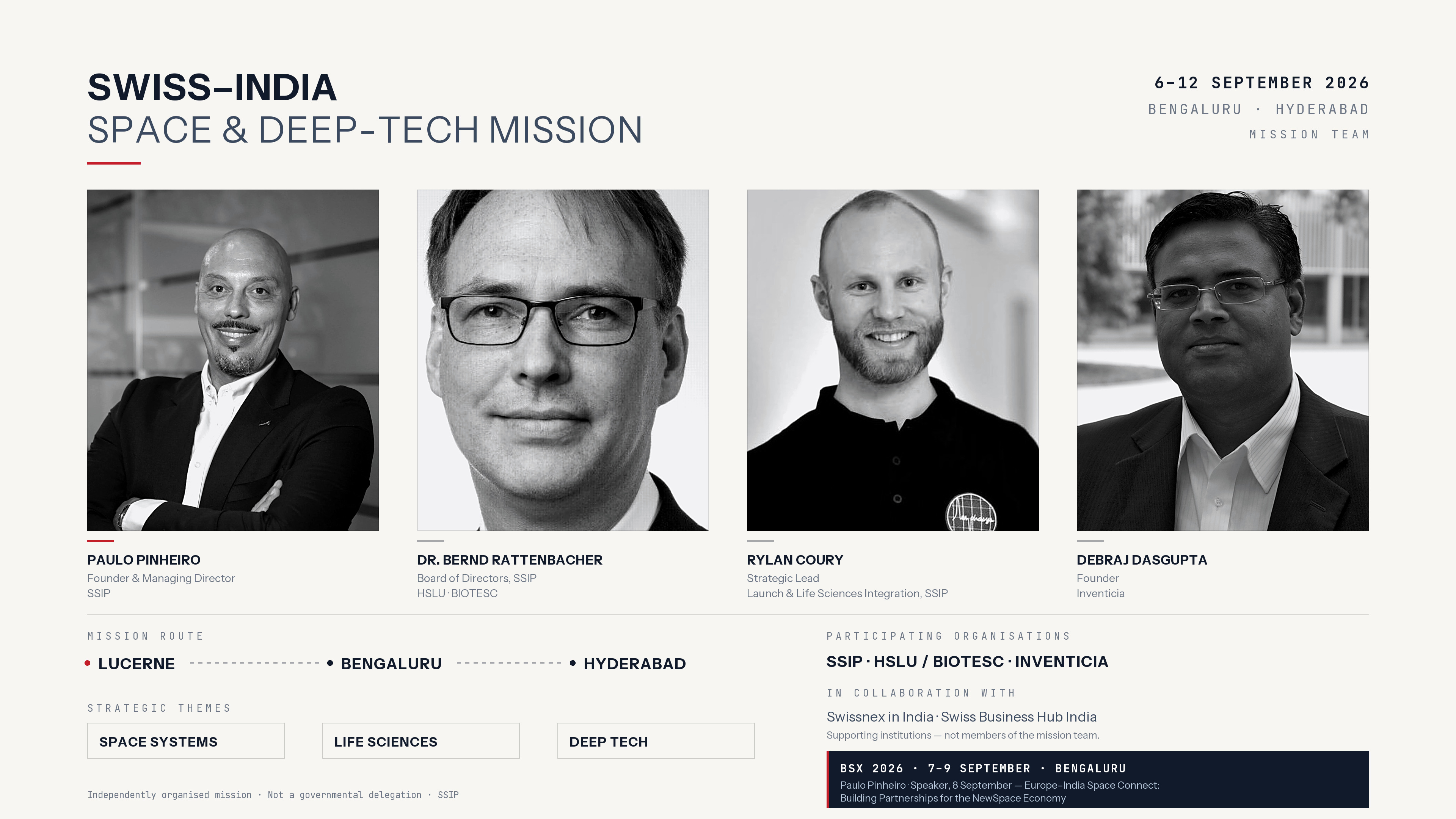
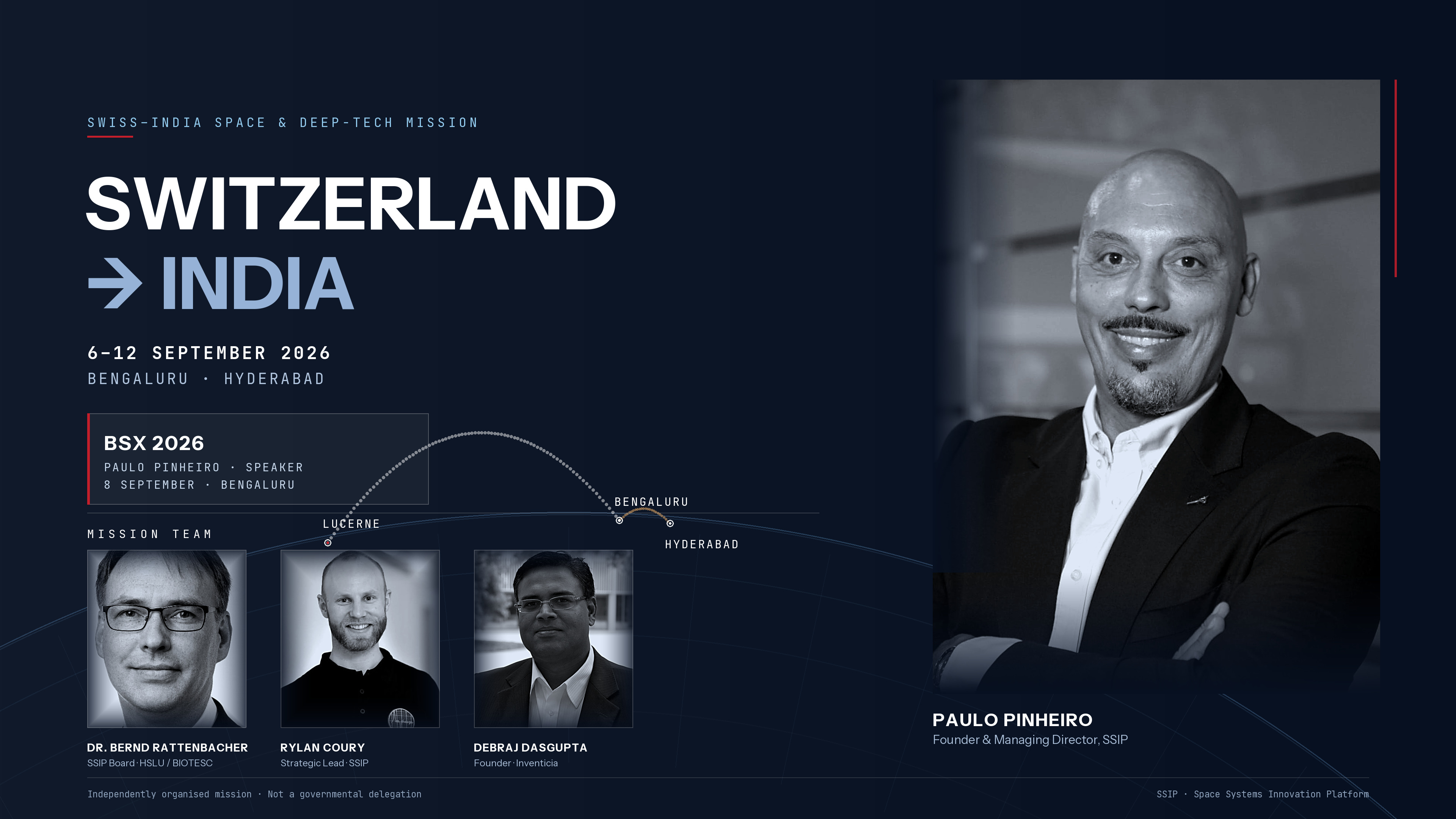
From 6 to 12 September 2026, a four-person team from Space Systems Innovation Platform (SSIP), Lucerne University of Applied Sciences and Arts (HSLU) and Inventicia will travel to Bengaluru and Hyderabad for an independently organised Swiss–India Space & Deep-Tech Mission focused on one objective: turning international connections into practical opportunities for research, technology and industry.
The mission brings together Paulo Pinheiro, Dr. Bernd Rattenbacher, Rylan Coury and Debraj Dasgupta, combining experience across space systems, microgravity research, life sciences, technology commercialisation and international ecosystem development.
The mission is being developed with collaboration from Swissnex in India and the Swiss Business Hub India.
Importantly, the mission is not an official delegation of the Swiss Confederation, carries no governmental mandate and does not represent the Swiss government. It is an independent initiative of the participating organisations.
That distinction matters — and so does the timing.
Why India, why now?
India's space sector is undergoing one of the most significant transformations in the global NewSpace economy.
Reforms introduced since 2020 have opened space activities to substantially greater private-sector participation, with IN-SPACe created to promote, enable and authorise activities by non-government space entities.
The result is an increasingly dynamic ecosystem spanning launch, satellites, Earth observation, advanced engineering, software, AI, research infrastructure and commercial space services.
For organisations based in Switzerland, the opportunity is not to compete with India on scale.
It is to connect complementary strengths.
India brings a rapidly expanding technology ecosystem, engineering talent, private space companies, digital capabilities and a large domestic market. Switzerland brings deep expertise in precision engineering, advanced manufacturing, life sciences, applied research and highly specialised technology.
The intersection between those capabilities is where this mission intends to operate.
A seat at one of India's key space gatherings
At the centre of the Bengaluru programme will be the 9th Bengaluru Space Expo — BSX 2026, taking place from 7–9 September at the Bangalore International Exhibition Centre.
The event brings together institutional, industrial and international actors from across the rapidly evolving space economy.
For SSIP, participation goes beyond attending the exhibition.
On 8 September, Paulo Pinheiro, Founder and Managing Director of SSIP, will join the Europe–India discussion in Cassia Hall focused on:
“Building Partnerships for the NewSpace Economy”
The subject goes directly to a central question facing international NewSpace:
How can scientific capability, technology, industrial infrastructure and market access be connected in ways that lead to deployable projects rather than isolated conversations?
Four people, complementary capabilities
The mission is deliberately compact.
Paulo Pinheiro, Founder and Managing Director of SSIP, leads the platform's international development, industrial engagement and ecosystem-building activities.
Dr. Bernd Rattenbacher combines two particularly relevant roles. He serves on the Association Board of SSIP while also bringing HSLU's scientific and operational experience through BIOTESC.
BIOTESC supports biological research and experiments associated with microgravity and spaceflight, providing the mission with a direct connection between applied research, space operations and the emerging opportunity for space-enabled life sciences.
Rylan Coury, SSIP's Strategic Lead for Launch & Life Sciences Integration, adds the perspective of connecting biological and scientific requirements with the space systems and infrastructure required to make those activities operational.
Debraj Dasgupta, Founder of Inventicia, brings extensive international life-sciences experience together with a strong focus on the India–Switzerland business and innovation corridor.
Together, the four profiles span capabilities that increasingly need to converge in the commercial space economy:
Science. Space infrastructure. Industrialisation. Market access.